
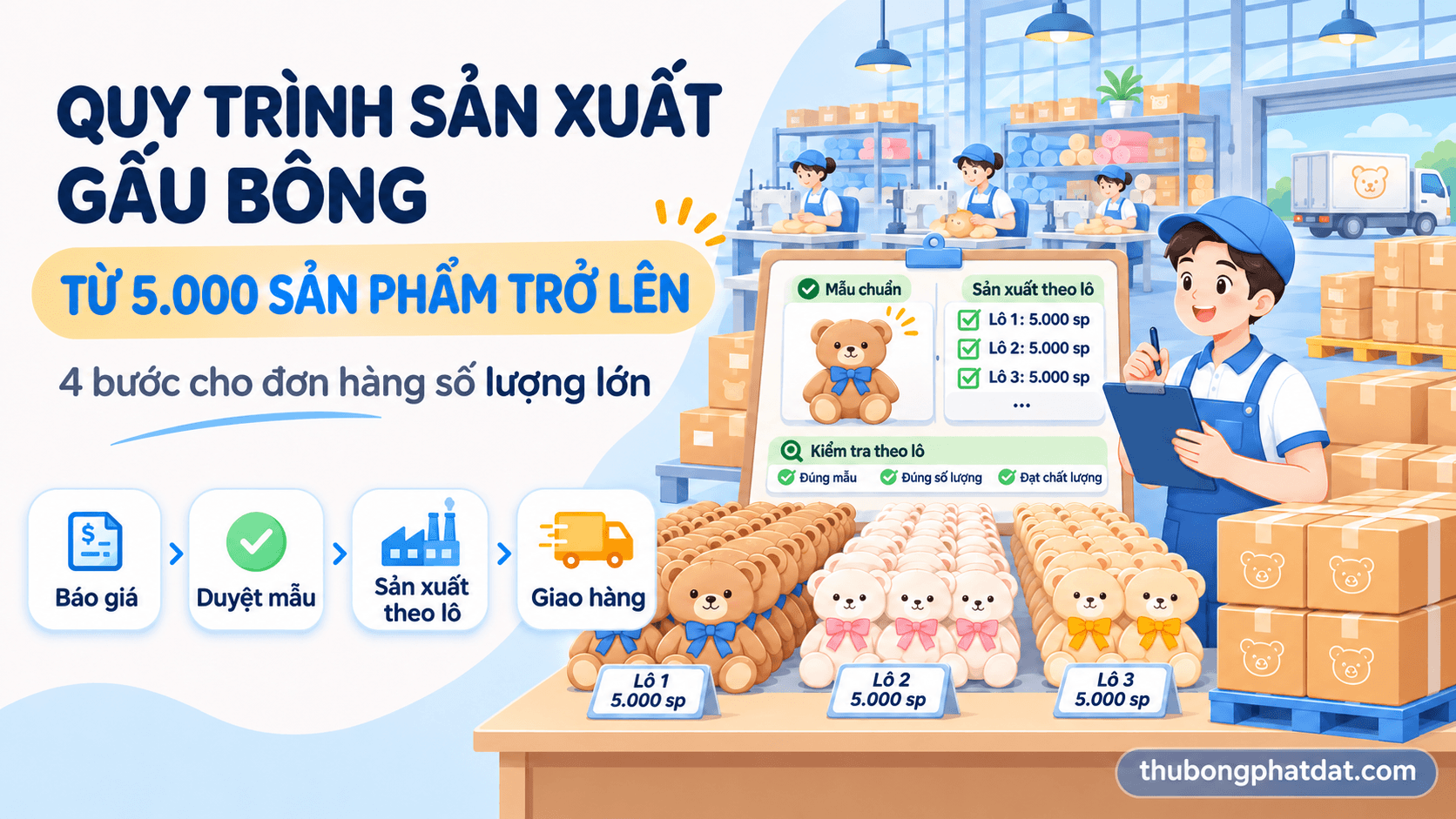
For custom plush orders of 5,000 units or more, the challenge is not only making an approved design once but also maintaining consistency across many units, colors and production groups. This guide follows four steps: discussion and quotation, sample development and approval, manufacturing and inspection, followed by packaging and delivery. The 5,000-unit threshold defines the topic of this guide; it does not establish Phat Dat's minimum order quantity or promise a daily production capacity.
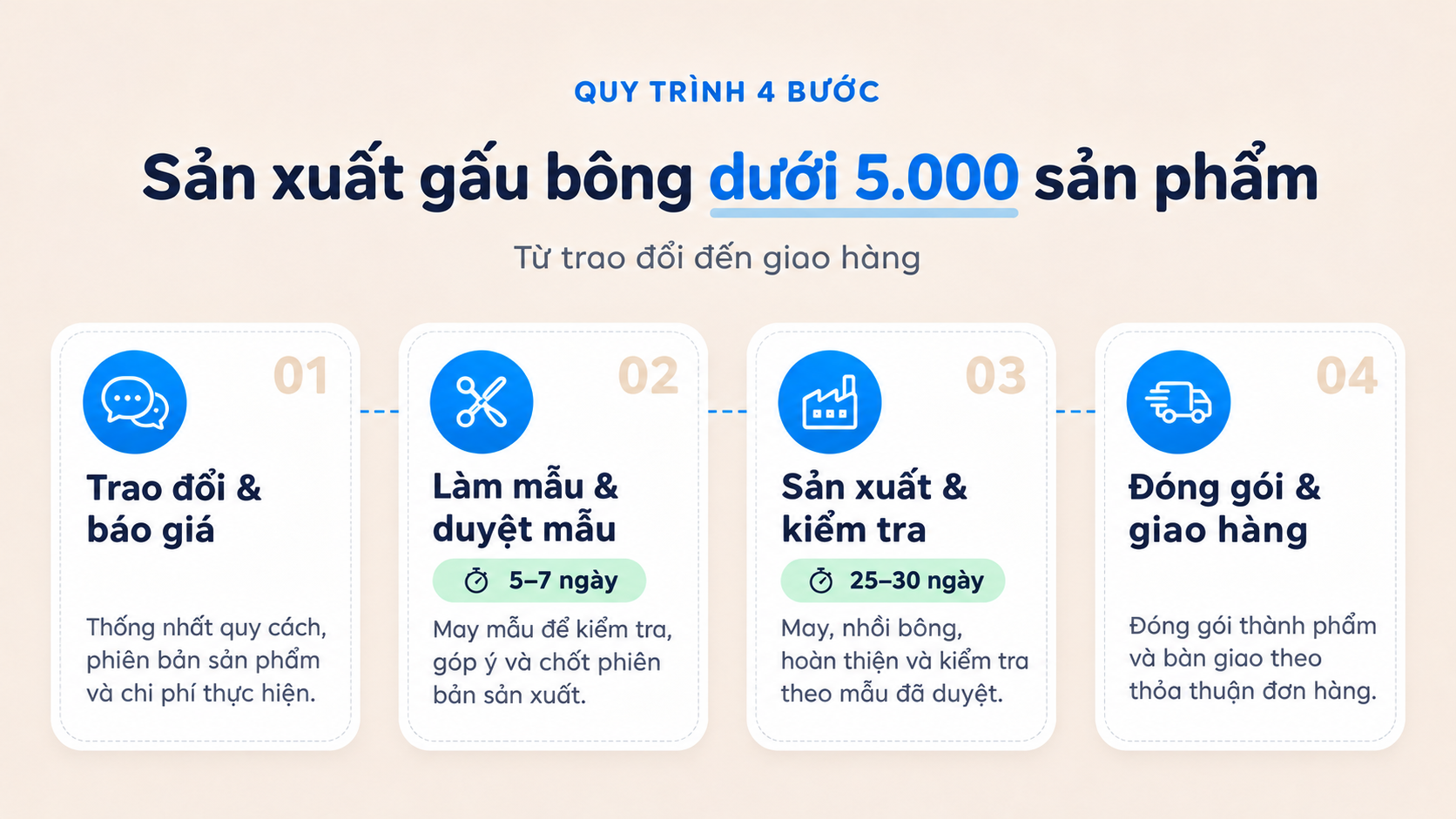
The infographic uses Vietnamese labels and shows the same four stages as the under-5,000-unit guide. Any example time ranges shown in the image are illustrative, not guaranteed lead times. For 5,000+ units, the key differences are version control, production-group inspection and shipment coordination.
1. Discussion & quotation for larger plush orders
Share drawings or reference photographs, the character concept, dimensions, colors, intended use, destination market, overall quantity and desired delivery date. If the order contains several mascots, colorways or labeling versions, list quantities for each variation rather than supplying only one total. That breakdown helps identify materials, manufacturing details and packaging needs.
Discuss preferred fabrics and filling, embroidery or printing, accessories, branding, packing and any project-specific documentation. The quotation should identify the versions and quantity assumptions, what is included and what still requires approval. No fixed price, deposit percentage or production lead time can be inferred from the total quantity alone.
Checkpoint: a design-and-quantity breakdown, proposed quotation scope and the sample requirements to confirm.
Difference at the quotation stage: Smaller orders may focus on clarifying a few versions; at 5,000+ units, quantities by SKU, color, label and proposed delivery groups need a more detailed breakdown so requirements remain aligned across the project.
2. Develop & approve the reference sample
Review proportions, character expression, size, materials, fullness, colors, seams, embroidery or printing and tags against the artwork. Keep revision notes tied to a clearly identified sample version. For large orders, version control is especially useful: separate teams should not rely on conflicting sample photographs or inconsistent instructions.
.jpg.webp)
After sample approval, maintain a reference set with multi-angle images, measurements, colors, branding positions, labels and agreed packaging details. Assess any later changes for their potential effects on price, scheduling and units already produced. Sample fees, revision arrangements and timing should be confirmed for the actual order, not assumed from older published terms.
Checkpoint: an approved sample and versioned specifications for the whole order.
Difference at sample approval: For smaller orders, the buyer may review individual variations directly. At 5,000+ units, a single approved reference set and controlled versions help different production groups follow the same standard.
3. Manufacture & inspect production groups
Once the sample is approved, manufacturing may include material preparation, cutting, embroidery or printing, sewing, filling and finishing. For 5,000 or more units, identify materials and completed items by design, color or version as appropriate. Recording production groups and checkpoints can help reconcile quantities between activities, particularly when several designs or deliveries are involved.
.jpg.webp)
Agree on inspection criteria based on the approved sample: size, shape, seams, embroidered or printed features, fullness, labels, accessories and appearance. Rather than relying solely on a final item, discuss an inspection approach suited to each production group, how discrepancies are recorded and how decisions to address them are made. Visual inspection does not demonstrate compliance with a specific safety standard; testing and records must be considered separately for the actual products and destination markets.
Checkpoint: quantities by version, conformity with the approved sample and a documented approach for discrepancies before packing.
Difference during manufacturing: A smaller order can emphasize checks by design or small group. At 5,000+ units, tracking production groups, item codes and inspection checkpoints becomes more important for identifying inconsistencies before the whole batch is finished.
4. Package & deliver larger orders
Sort and package products based on size, variation and agreed presentation or handling needs. For orders with multiple versions or delivery locations, carton identification and quantities per carton help buyers verify shipments. Packing quantities should be selected for the actual products rather than based on a universal bag or carton rule.
.jpg.webp)
Before dispatch, confirm handover dates, addresses, recipient contacts, transport arrangements and each party's responsibilities. One delivery or several shipments may be agreed based on the project; an order of 5,000 units does not automatically include free shipping. Consult the published shipping policy together with the specific purchase agreement.
Final checkpoint: quantities, product versions, cartons and agreed delivery conditions are reconciled, with a process for handling discrepancies.
Difference at delivery: Smaller orders often have a simpler handover. At 5,000+ units, carton identification, quantities by version and possible shipment or receiving-location splits deserve more attention; multiple deliveries or free shipping are not automatic.
Under 5,000 vs 5,000+ units: what actually changes?
The workflow still has four steps; what changes is the level of coordination. The under-5,000-unit guide emphasizes approving designs and tracking smaller groups or variations. For 5,000+ units, approved reference versions, quantities by SKU, production-group inspections, carton reconciliation and shipment planning need closer attention. These are planning differences, not universal guarantees about capacity, lead times or delivery terms.
Compare the guide for orders below 5,000 units or the general custom plush ordering process for related background.
Discuss a larger custom plush order
Send Phat Dat drawings or references, quantity breakdowns, preferred materials and packing, intended markets, a target delivery date and receiving locations through the quotation inquiry page, +84932760683 or [email protected]. Feasibility, sample approval, prices and scheduling are agreed for each project.